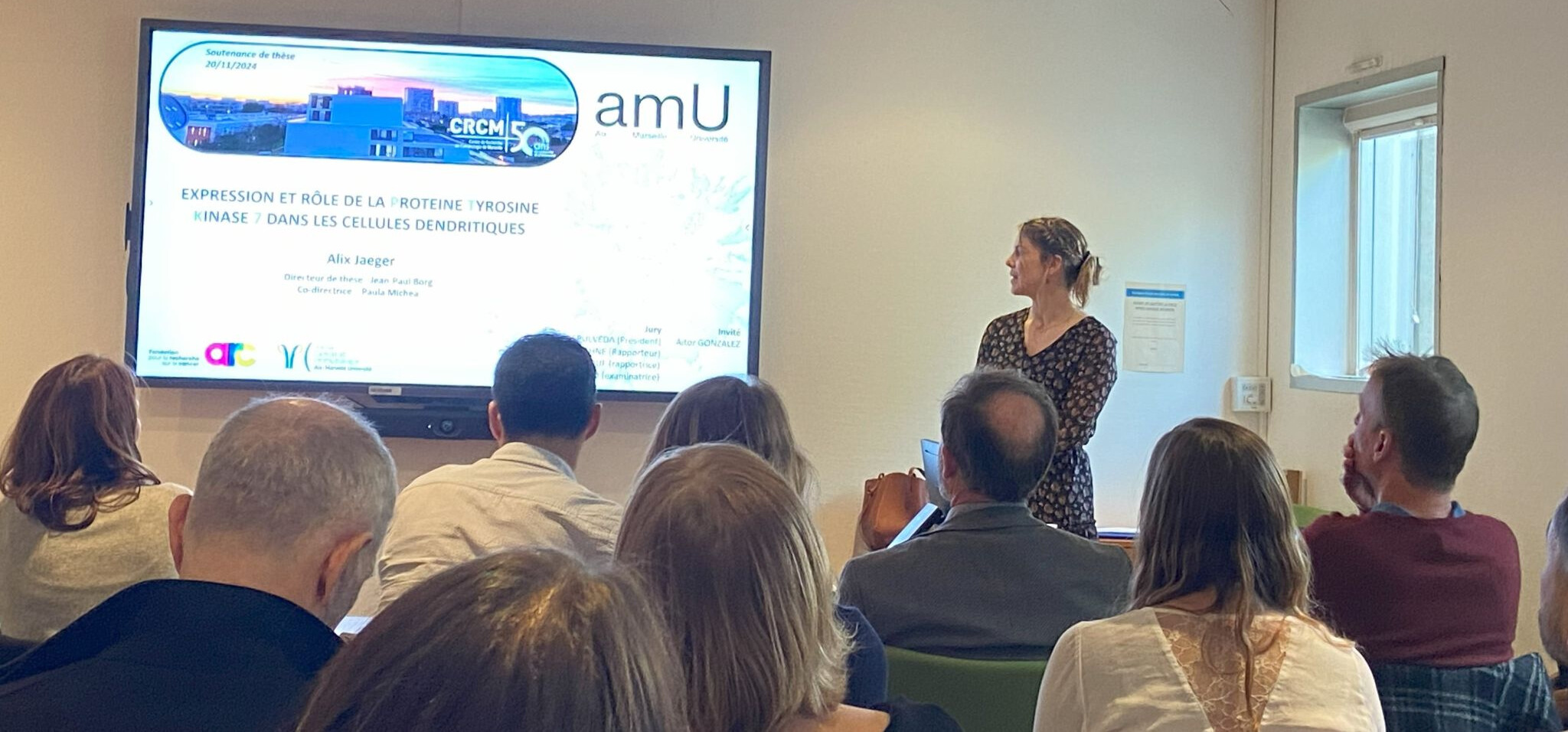
Alix Jaeger defended her thesis "Role of Protein Tyrosine Kinase 7 (PTK7) in dendritic cell function" on November 20, 2024.
Summary:
Tumor cells can colonize tissues during the metastatic process, reflecting the aggressiveness of cancers. The "Targeting signaling networks and the microenvironment in cancer" team, co-directed by Jean-Paul Borg and Flavio Maina at CRCM, focuses on membrane receptors involved in metastatic development. Such is the case of Protein Tyrosine Kinase-7 (PTK7), a member of the receptor tyrosine kinase family. PTK7 plays a role in tumor cell adhesion, migration and invasion, making it a target for antibody and chimeric antigen receptor (CAR)-T therapies. Recently, PTK7 was identified on the surface of immune cells capable of infiltrating tumors: dendritic cells (DCs). However, the function and regulation of PTK7 on the surface of DCs, and its impact on tumor progression, remain unknown. DCs are antigen-presenting cells that play an essential role in initiating the adaptive and anti-cancer immune response, presenting antigen to naive T lymphocytes (LTs), which then differentiate into effector LTs or regulatory LTs. Thus, DCs play a central role in the regulation of innate and adaptive immunity, providing the balance between maintenance of immune tolerance and immune activation. The main aim of my thesis will therefore be to study the function of PTK7 expressed by DCs in tumor progression and the mechanisms put in place by the tumor microenvironment to regulate this expression. Results obtained by Alix Jaeger, a 4th year PhD student in the host laboratory, indicate that PTK7 identifies a population of DCs with tolerogenic properties. Indeed, in a physiological context, DCs expressing PTK7 induce lower proliferation and activation of CD4+ LTs and CD8+ LTs, as well as an increase in regulatory LTs, compared with DCs not expressing PTK7. On the other hand, PTK7 expression appears to be increased in certain tumor-infiltrating DC subtypes in murine models of melanoma and breast cancer. These results lead us to postulate that PTK7 on the surface of DCs is controlled by the tumor microenvironment and has a pro-tumor role. The project is organized around 3 objectives: Objective 1: Determine the function of PTK7+ DCs in tumor progression, in vivo; Objective 2: Study the regulation of PTK7 expression on the surface of DCs by the tumor microenvironment; Objective 3: Understand the mechanisms of PTK7 signaling in intra-tumoral DCs. Experimental approach: Objective 1: Using mouse models set up in the host laboratory: mice deficient for PTK7 in DCs (CD11c-Cre x Ptk7-Flox/Flox), B16 syngeneic melanoma model, I will be able to determine whether the absence of PTK7 specifically in DCs (only CD11c+ cells expressing PTK7) has an impact on the anti-tumor immune response, tumor regression or the appearance of metastases. Objective 2. I will identify the factors in the tumor microenvironment responsible for PTK7 regulation using a bone marrow-derived DCs model already established in the laboratory, as well as a B16 melanoma model. I will then study the PTK7 intererectome by mass spectrometry. Objective 3: Finally, I will determine the signaling pathways associated with PTK7 in the presence or absence of the regulators identified in Objective 2. To this end, I will analyze the PTK7 interactome using the bone marrow-derived DC model. The marrow will be obtained from BirA knock-in mice, which allow constitutive and endogenous expression of PTK7 fused to biotin ligase. This model will enable me to perform proximity biotinylation to identify PTK7-interacting proteins in DCs.